
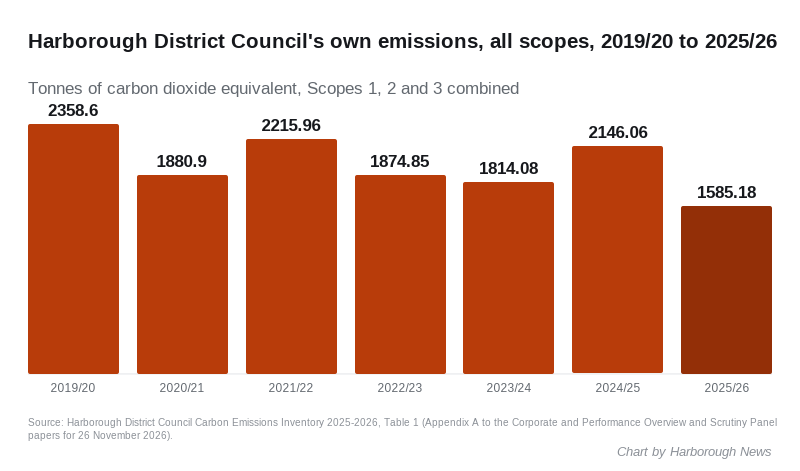
Harborough District Council's own emissions fell 26.1% in 2025/26, its new inventory shows. A report to scrutiny on Thursday leaves the 2030 net zero target unchanged.
Harborough District Council’s own carbon emissions fell by 26.1% in the year to March 2026. The biggest single cut came from new solar panels and repairs at the district’s two leisure centres.
The figures are in the council’s emissions inventory for 2025/26. It goes to the Corporate and Performance Overview and Scrutiny Panel on Thursday 26 November at 6.30pm.
The covering report makes no change to the council’s climate commitments. It says it “does not propose changes to the Council’s existing climate commitments or 2030 operational net-zero ambition”. In September the council’s leader said he wanted the 2019 climate emergency declaration and the 2030 target dropped, as a personal view. Nothing in Thursday’s papers takes that forward.
The numbers
The inventory counts emissions from the council’s own buildings and from the services it pays others to run. In 2025/26:
- total emissions were 1,585.18 tonnes, down from 2,146.06 tonnes the year before
- that is 32.8% below 2019/20, the year the council uses as its baseline
- emissions from its own gas and electricity use (Scopes 1 and 2) were 350.25 tonnes, down 5.4% on the year and 35.6% on the baseline
- emissions from contracted services (Scope 3) were 1,234.93 tonnes, 540.84 tonnes lower than a year earlier and the lowest since monitoring began
The figures come from Table 1 of the inventory. This year the summary percentages match the table. Last year’s did not, which we reported in September.
Where the cut came from
Most of it came from the leisure centres in Market Harborough and Lutterworth, which are run under contract for the council. Their combined gas and electricity emissions fell from 778.7 tonnes to 206.01 tonnes, the inventory says.
Solar panels went on both buildings in May 2025:
- Harborough Leisure Centre: 1,174 panels, 516.56kWp
- Lutterworth Leisure Centre: 458 panels, 261.52kWp
The inventory also credits repairs to poorly working equipment, better lighting and insulation, and new heating and ventilation units.
Lower carbon factors for grid electricity helped too. The council’s own electricity emissions fell 12.8%, helped by new LED lighting in the Symington Building, its main offices.
What went the wrong way
Gas use at the Market Hall went up. Its gas emissions rose from 38.37 tonnes to 49.43 tonnes, with the heaviest use in April and May 2025 and January and February 2026. The inventory says roof repairs in spring and summer 2025 may have let more heat escape, and the solar panels had to come off the roof while the work was done.
Bin lorries and other contractors’ vehicles produced 962.23 tonnes, a slight rise. The inventory says an electric fleet “is not currently possible over the distances required” in a large rural district. It adds that the new food waste collections will increase the miles driven.
Is 2030 within reach?
The inventory is plain that the council still has “a significant challenge” to reach net zero for its own buildings by 2030. Its direct emissions can only fall further by replacing the gas boilers in its four main buildings.
- A heat pump for the Market Hall’s larger hall has capital funding in the 2026/27 budget.
- The Harborough Innovation Centre’s biomass boiler is due to be swapped for a heat pump in 2027.
- Replacing the Symington Building’s boilers is “too high at the moment”, the inventory says, “particularly with the uncertainty of Local Government Reorganisation”.
The report adds that there is no dedicated budget for the climate emergency work. Each project has its own funding.
The inventory expects 2026/27 to be the council’s last, on the basis that Leicestershire’s councils are reorganised. The government withdrew its July decision on the county’s councils on 29 October and has not yet made a new one.
The wider district
The council’s own emissions are a tiny share of the district’s. Its annual climate report puts the whole district’s greenhouse gas emissions at 711.6 kilotonnes in 2024, the latest government figures. That is 6.8 tonnes per person, down from 7.1 tonnes in 2023.
Transport is the biggest source, at 42%, and 130.2 kilotonnes of that comes from motorway traffic. Agriculture follows at 25%, then homes at 18%. The district’s figure per person is still above Leicestershire’s 5.8 tonnes and England’s 4.7.
What it means for you
The scrutiny panel meets in public on Thursday 26 November at 6.30pm. It will not make a decision. Councillors are asked to note the progress and to suggest how climate work should be measured and reported in future.
Energy saved is money saved, and the report ties the two together. It says any future project must show value for money over its expected life, taking account of carbon savings and the reorganisation of councils.
Sources
- Corporate and Performance Overview and Scrutiny Panel, 26 November 2026, Harborough District Council: agenda item “Climate Change: Progress and Current Activity”, with Appendix A, the Carbon Emissions Inventory 2025-2026, and Appendix B, the Climate Emergency Annual Report 2025/26. Read on 22 November 2026.
Have your say