
Council leader Simon Whelband wants the 2019 climate emergency and 2030 net zero pledge dropped. The council's own emissions rose 12% in 2024/25.
The leader of Harborough District Council wants the council to drop its climate emergency declaration and its target of net zero by 2030. Cllr Simon Whelband, who leads the Conservative administration, set out the view in a Facebook post over the weekend.
He has stressed that it is his personal view. It is not a change in council policy, and nothing has yet been put to councillors.
What the leader said
Cllr Whelband’s words were carried identically by the BBC and the Harborough Mail. He said the language of a continuing “climate emergency” is alarmist, and that “setting an arbitrary net zero deadline is the wrong way to make policy”.
“It puts a target ahead of the practical consequences, costs and benefits of the decisions we take,” he said.
He told both outlets the council was wrong to declare a climate emergency and should reconsider its position. He also said any formal change would have to go through the council’s democratic process. He said practical steps that save money, such as the energy-efficiency work on council buildings, should carry on.
Green Party and Liberal Democrat councillors have spoken against the idea, and the Lib Dem group leader, Cllr Phil Knowles, has asked for it to be debated by councillors soon. Both groups set out their views in interviews with Harborough FM.
What the council actually committed to in 2019
The council declared a climate change emergency on 24 June 2019. It had already signed the Local Government Association’s Climate Local agreement in 2013.
The climate emergency action plan that followed is built into the council’s Corporate Plan 2022-31. It has six commitments:
- to show political and corporate leadership on climate change
- to cut emissions from the council’s own buildings and services to net zero by 2030, “as far as practical”
- to help residents and communities cut emissions and cope with the effects of climate change
- to do the same for businesses
- to make sure new development is designed to cut emissions and withstand climate change
- to work with partners on natural systems, such as river catchments, that reduce the impacts
The 2030 target covers the council’s own operations only. It is not a target for the whole district.
How far the council has got
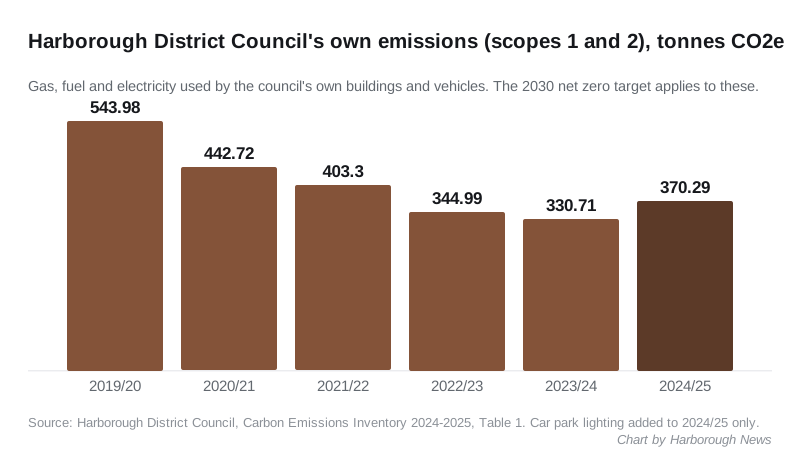
The council’s Carbon Emissions Inventory for 2024/25 counts the gas, fuel and electricity it uses directly. These are scopes 1 and 2, the part the 2030 target is measured against.
| Year | Scope 1 and 2 emissions (tonnes CO2e) |
|---|---|
| 2019/20 (baseline) | 543.98 |
| 2020/21 | 442.72 |
| 2021/22 | 403.30 |
| 2022/23 | 344.99 |
| 2023/24 | 330.71 |
| 2024/25 | 370.29 |
That is a fall of 173.69 tonnes, or 31.9%, since the 2019/20 baseline. But the latest year went the wrong way, up 39.58 tonnes on 2023/24. By the table’s own figures that is a rise of about 12%. The report’s written summary gives 7.3%, which does not match its table.
The report blames three things for the rise:
- a longer heating season, so more gas was burned
- a 2.5% rise in the carbon intensity of gas per kWh
- car park lighting counted for the first time
The report names four buildings as the biggest emitters in scopes 1 and 2: the Symington Building, the Market Hall, Harborough Innovation Centre and Harborough Enterprise Centre.
Contracted services are counted separately as scope 3 and sit outside the 2030 target. In 2024/25 they came to 1,775.77 tonnes. Of that, 907.73 tonnes came from the bin collection, grounds maintenance and street cleaning vehicles, and 778.7 tonnes from the two leisure centres.
What the latest progress report says
The climate update that went to Cabinet on 24 September is Appendix 9 of the year-end performance report. It says the council still has 370.29 tonnes to cut over five years to reach net zero. It records “a small increase in scope 1 and 2 emissions” and says the council is working towards carbon offsetting.
Work listed for 2025/26 includes:
- LED lighting throughout the Symington Building
- work on the Symington Building’s windows to keep heat in
- a new solar array at Harborough Innovation Centre
- a climate adaptation officer working with flood-hit communities, flood action groups and flood wardens
The main report is franker about money. It says “only some of the capital initiatives relating to achieving net zero are being implemented”, and that the capital programme is under review. The annual emissions report and the work towards net zero are due at scrutiny in November 2026.
Could it actually be scrapped?
The declaration was a decision of the full council, and changing it would need councillors to vote. The Conservatives run Harborough as a minority. They hold 15 of the 34 seats, so they cannot carry a vote on their own.
The other seats are held by:
- Liberal Democrats: 8
- Green Party: 3
- Independents: 3
- Labour: 2
- Reform: 2
- Restore Britain: 1
What it means for you
Nothing changes yet. The declaration and the 2030 target remain council policy until councillors vote otherwise. Grants, flood-resilience work and the energy work on council buildings continue.
If you have a view, your district councillor is the person to tell. You can find yours on the council’s councillors page. Council meetings are open to the public.
We will report the November scrutiny papers when they are published, and any motion if one is tabled. For how the council is run and what it charges, see our Market Harborough council tax bands page.
Have your say