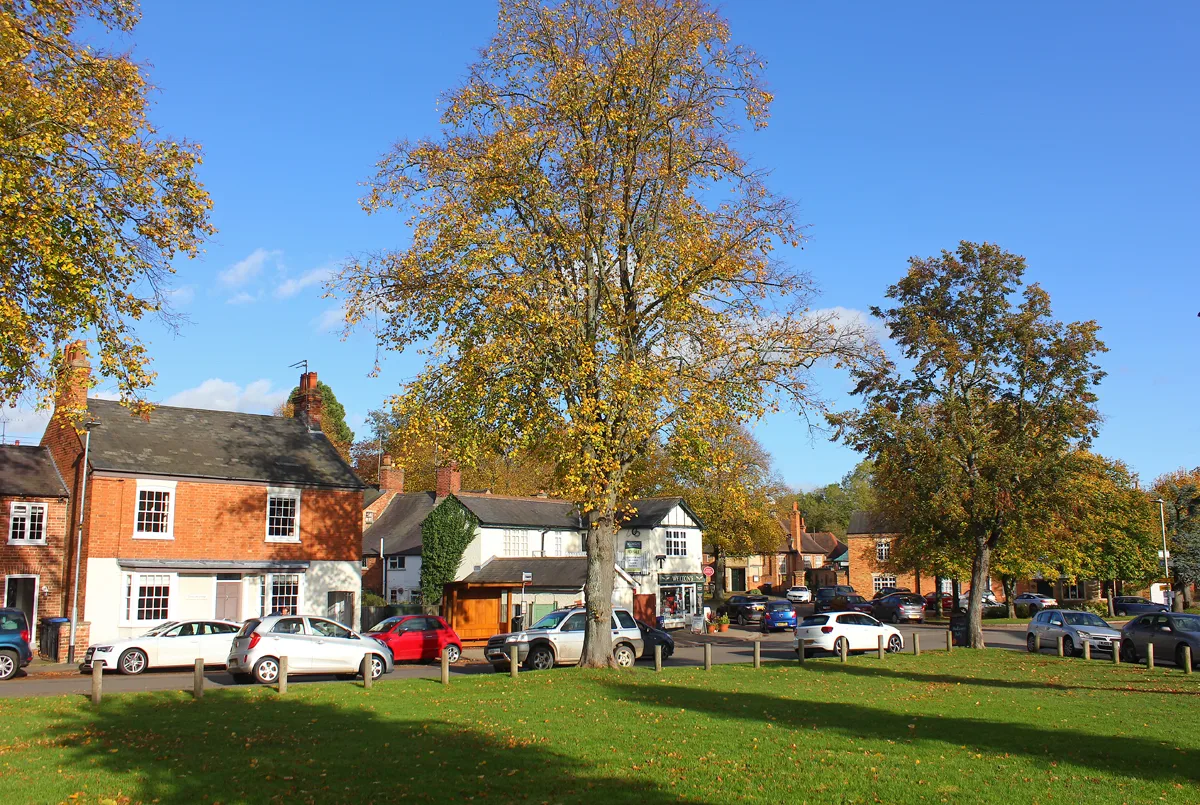
Both parishes hold a referendum on 8 October. Great Bowden's plan lost its only housing site, eight bungalows off Buckminster Close, during examination.
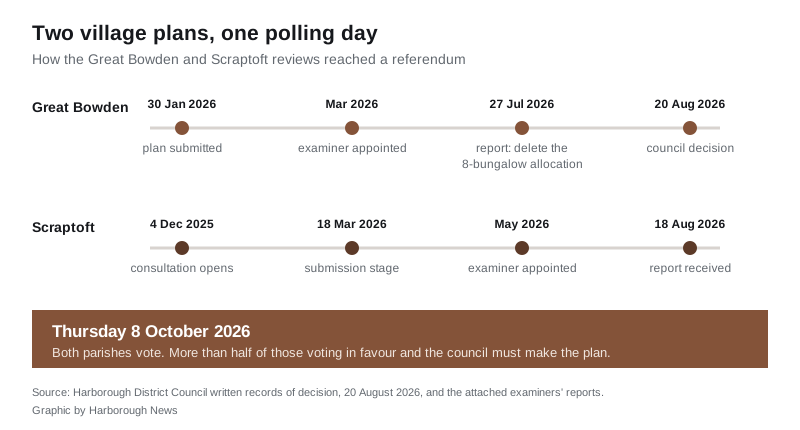
Two Harborough villages will vote on their neighbourhood plans on Thursday 8 October. Harborough District Council’s Director of Planning signed both decisions on 20 August, and they were published on the council’s delegated decisions register this week.
Both parishes already have a neighbourhood plan in force. Scraptoft’s covers 2015 to 2028 and was made on 11 March 2016. Each has now been reviewed and rewritten, and each review goes to a vote of everyone on the electoral register in the parish.
One of them will go to that vote without the housing site it was written around.
Great Bowden’s eight bungalows were cut at examination
Great Bowden Parish Council’s plan proposed a single housing allocation: eight bungalows on land off Buckminster Close, the site the plan calls GB01. The independent examiner recommended that the policy be deleted, and the council accepted the recommendation.
The policy would have been unusually tightly drawn. It required:
- bungalows only, to a total of eight
- a mixture of two and three bedrooms
- a restrictive covenant preventing conversion into a house with an upper storey, or living space in the eaves with dormer windows
- priority in marketing to Great Bowden residents in the first instance
The site is 0.79 hectares, which the examiner calculated at roughly ten homes per hectare.
The problem was heritage evidence. The site sits inside the Great Bowden Conservation Area. Historic England told the council it is next to the Grade I listed Church of St Peter and St Paul and the Grade II* listed Old Rectory, and that the parish’s own existing plan already protects it as Site V, a site of historical environmental significance.
Historic England asked for a Heritage Impact Assessment at the pre-submission stage. Harborough District Council asked for one too, noting multiple Historic Environment Record entries within or next to the site. None was produced.
The parish council disputed the objection. It told the examiner the site is a paddock enclosed on three sides by modern housing with no intervisibility with the church, pointed to a 2022 heritage statement accepted for the adjoining parcel, and offered to commission a proportionate assessment.
The examiner did not accept that it could be done afterwards:
“It would be too late to undertake the Heritage Impact Assessment once the Plan had been made or at the planning application stage because if the identified impacts mean that the site cannot be developed then the allocation would be ineffective. In addition, there would be insufficient information for HDC to decide whether the Plan meets the basic conditions and should proceed to referendum, or for residents in the neighbourhood area to be able to determine how they should vote in a referendum.”
That last line is the point for anyone voting on 8 October. The examiner removed the allocation partly so that residents would not be asked to vote on a site nobody could yet judge.
He was otherwise complimentary about the plan, calling it “an excellent example of a review of a neighbourhood plan”.
The village’s own growth figures
In its evidence to the examination, Great Bowden Parish Council set out how much the village has already taken:
- more than 230 dwellings built between 2011 and 2020
- houses up from 449 to 679, a rise of 51%
- a further 100 homes proposed for the village in the draft Local Plan now at examination
The housebuilder Jelson Homes objected to the allocation from the opposite direction. It argued the site already sits inside the settlement boundary, so it would come forward anyway as a windfall, and allocating it risks double counting against the windfall supply the council already assumes: 225 dwellings by 2031 in the adopted plan, and another 450 by 2041 in the emerging one, at 45 a year from 2031/32.
The examiner concluded there was nothing to prevent a parish from allocating a site inside its own settlement boundary. It was the missing heritage evidence, not the principle, that killed the policy.
Scraptoft’s plan allocates nothing, and re-draws the map
Scraptoft’s review, examined by Tim Jones, takes a different route. It does not allocate any housing sites at all. It runs to 2041 and instead sets out where development can happen and what is protected.
The changes that matter locally:
- a new settlement boundary for the built-up area, with different rules inside and outside it (Policy HBE1)
- Local Green Spaces cut from five sites to two after every open space in the parish was re-assessed against the national criteria (Policy ENV2)
- a new policy covering nineteen open space, sport and recreation sites, where the made plan had none (Policy ENV3)
- new protection for surviving ridge and furrow, for non-designated heritage assets, and for named important views
- new policies on flood risk resilience and on where wind turbines and solar arrays would be supported
Housing mix and affordable housing policies were both rebuilt on 2021 Census data and a housing needs assessment commissioned for the review.
Scraptoft’s consultation ran for six weeks from 4 December 2025 to 23 January 2026, then again from 18 March to 29 April 2026. The final examiner’s report reached the council on 18 August, two days before the decision to send it to referendum.
What it means for you
If you live in either parish and are on the electoral register there, you get a vote on 8 October. The referendum area for Great Bowden is the neighbourhood area the district council approved on 5 December 2015. For Scraptoft it is the parish.
If more than half of those voting back the plan, the council must make it. At that point it stops being a document and becomes part of the development plan, which is what planning officers and the planning committee have to decide applications against.
That is why the deleted allocation matters. Land off Buckminster Close has not been protected from development by its removal. The site sits inside the settlement boundary, so an application could still come forward as a windfall, and it would then be judged without the bungalows-only rule and the covenant the parish had attached to it.
Election arrangements, including polling places and the exact question, are set by the council’s election services under the referendum regulations and have not yet been published.
Harborough district now has 30 neighbourhood plans that have been made and ten that have been through a successful review. Each of these two reviews will let the council claim a £20,000 Neighbourhood Plan Delivery Grant from the Ministry of Housing, Communities and Local Government. The grant is £10,000 where a plan needs examination only, and nothing where the changes are non-material.
If you want to check how either plan would affect a specific address, the council’s planning pages are the starting point, and both parish councils hold the full plan documents.
Sources
- Written Record of Decision: Great Bowden NDP Referendum, Harborough District Council, 20 August 2026, including the examiner’s report by Andrew Ashcroft dated 27 July 2026
- Written Record of Decision: Scraptoft NDP Referendum, Harborough District Council, 20 August 2026, including the examiner’s report by Tim Jones received 18 August 2026
- Section 38A, Planning and Compulsory Purchase Act 2004, on what a council must do after a successful referendum
- Neighbourhood planning, Harborough District Council
Have your say
We read every message. To comment on this story, email the newsdesk and we may publish a selection of responses: hello@harboroughnews.co.uk.